


The making of offerings is an integral element of daily practice in the Tibetan Buddhist tradition. This practice finds its origins in ancient Indian hospitality as well as the arrival of the great Indian Vajrayana master, Atiśa, to Tibet. Centuries ago it was customary to present an arriving guest of some distinction with 7 gifts in the following order:
drinking water (Argham);
water to wash the feet (Padyam);
flowers (Pushpe) to place around the neck or hair;
incense (Dhupe) to clear any odor from travel;
light (Aloke) like a lamp to illuminate the room;
perfumed water (Gandhe) to soothe the mind and skin; and
food (Naivedya) to nourish them.
Buddhism flourished in India from the 5th through 11th centuries and many practitioners began to engage with the Buddhas and Bodhisattvas as the ultimate guests, thereby making these offerings each morning to welcome them. In the 11th century the great Master Atiśa arrived in Tibet where there were crystal clear waters readily available in streams, rivers and lakes. While most people there were quite poor they did have access to this pure water. So, he adapted the offerings to be seven water bowls. The Tibetan word for this offering is “yonchap”.
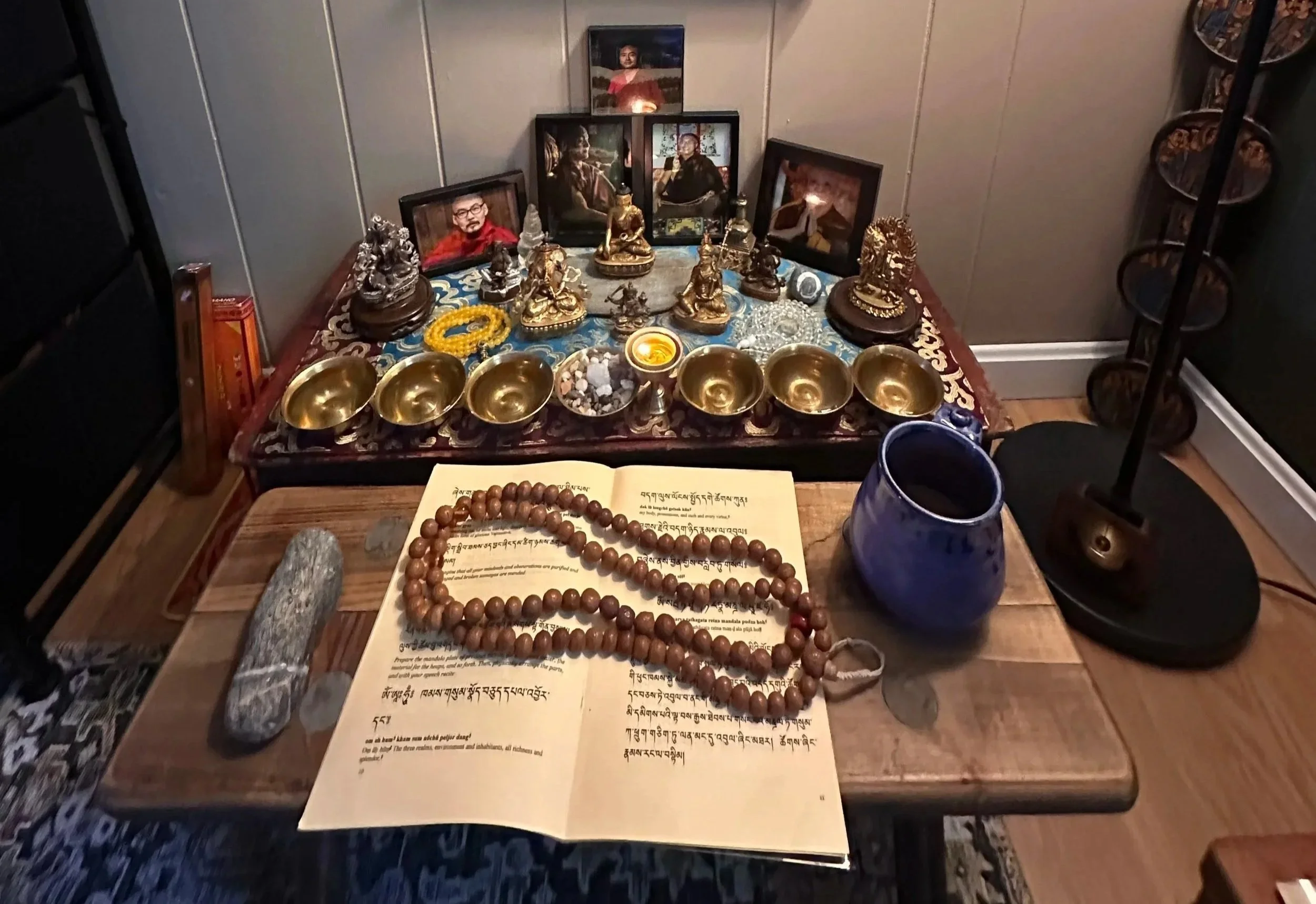
Cory’s home altar
Typically we start our practice by making this offering on an altar (but it can also be anywhere around the house or near a sacred place along a wall, on a table, etc.). After waking up and readying ourselves (wash face, use the restroom) we fill a nice pitcher with clean water and use that to fill the first bowl. Starting from left to right we then transfer all but about 1/7 of the water to the next bowl, and then like that proceed until each of the seven bowls contains a bit of water. As we do so the bowls are placed in a nice even line with about the width of a grain of rice/barley between each bowl. Then we take the pitcher and using both hands, while being careful not to spill, fill the bowls from left to right leaving about the width of a grain of rice/barley from the top of the bowl.
As we fill the bowls we chant “Om Ah Hum” to bless, purify, and transform the water so that it is protected from any negativity. While chanting one can then visualize each of the syllables dissolving down into the water transforming it to nectar. And it is thought that the vibration of the mantra multiplies the offerings to fill the space around the refuge tree.
Om (White): Represents the enlightened body of the Buddhas.
Ah (Red): Represents the enlightened speech of the Buddhas.
Hum (Blue): Represents the enlightened mind of the Buddhas.
One the offering is made some folks may follow it up with offerings of light (butter lamp or tea light), incense, and possibly even some food like oranges, bananas, etc., then dedicate and go about preparing for their day. For others this is just the beginning of the practice with prostrations, additional mantra/visualization and meditation. And practice is always concluded with dedication. Often we refer to this as the “three excellences”: excellence in the beginning (taking refuge and cultivating bodhicitta); excellence in the middle – the practice; and excellence in the end – dedication.
The offerings are part of the practice as a means to cultivate generosity. The Buddha pointed to six important mental states that we need to develop if we want to reach any of our positive goals in life. They’re usually translated as “perfections,” since by perfecting them fully as the Buddhas have, we too can attain liberation and enlightenment. Alex Berzin of Study Buddhism, a long time translator for the Dalai Lama, prefers to call them “far-reaching attitudes” in accord with their Sanskrit name, paramita, because with them we can reach the far shore of the ocean of our problems.
The six paramitas comprise the training of a bodhisattva, which is bodhićitta in action:
generosity: to cultivate the attitude of generosity;
ethical self-discipline: refraining from harm;
patience: the ability not to be perturbed by anything;
diligence/perseverance: to find joy in what is virtuous, positive or wholesome;
meditative concentration/mental stability: not to be distracted; and
wisdom/discriminative awareness: the perfect discrimination of phenomena, all knowable things.
According to Alex Berzin, developing them in our lives now brings us enormous benefits:
to enable us to avoid and solve problems;
to help us to rid ourselves of disturbing emotions and mental states; and
to empower us to be of best help to others.
In Buddhism generosity is seen as the ability to give — its essence being the mind that is able to let go. It’s about the mind dwelling behind/within the act of offering. It is giving without attachment, without expectation, and without any sense of loss.
To further our understanding, generosity can be described as three types:
Giving of material goods – as ordinary beings we need to be careful not to give something away that we will later regret (e.g., our body – such an ultimate level act is reserved for a fully enlightened bodhisattva — we would regret it).
Giving in accordance with one’s capacity.
Giving to one’s parents and those who are sick is seen as a very good act
It’s not limited to material things — give a smile, kindness, time, support, respect
Giving protection from fear (including animals).
Giving the sublime DHARMA (teachings/practices of Buddhism) - this one is supreme.
Shared by Cory M. Bryant, The Spiritual Pilgrim https://thespiritualpilgrim.com/
